
A/B Testing Tools in 2026 — A Cross-Market Analysis of Features and Pricing Across 8 Services
- research
- ab-testing
- cro
- pricing
- market-analysis
TL;DR
- We mapped 8 major A/B testing tools into two tiers: enterprise platforms and developer-first experimentation stacks
- Pricing spans three orders of magnitude — from free tiers to $200,000+/year
- Industry consolidation accelerated through 2025–2026: VWO and AB Tasty announced a merger agreement, and Statsig moved to Amplitude after being acquired by OpenAI
- Billing falls into three models — usage-based, seat-based, and traffic/MTU-based — each with very different cost behavior at scale
- Technically, the market splits into client-side tools (flicker-prone, marketer-driven) and server-side tools (engineering-dependent)
- All prices and specs are based on public information and third-party benchmarks as of June 2026 (sources listed at the end)
Once a heatmap shows you where a page has problems, the natural next step is an A/B test to verify what fixes them. As we design an A/B testing capability for HeatMapX, we surveyed the features and pricing of the major tools on the market. This post shares that research in a form we hope is useful for anyone evaluating these tools.
The pricing landscape at a glance
Lining up the 8 services by approximate annualized cost makes the market's polarization obvious.
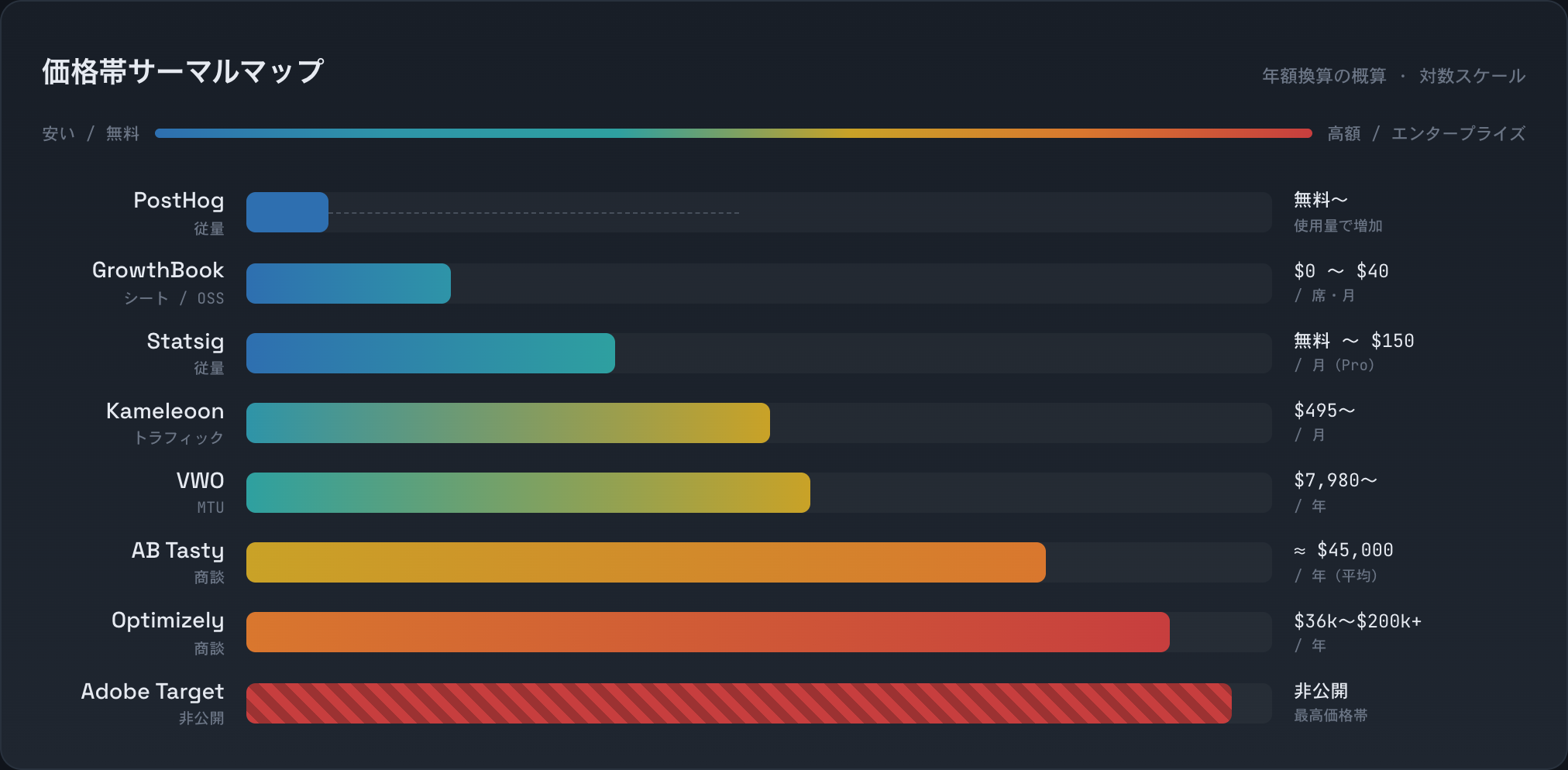
| Service | Tier | Price range (approx.) | Billing axis |
|---|---|---|---|
| Optimizely | Enterprise | $36,000–$200,000+/yr | Impressions / sales-led |
| Adobe Target | Enterprise | Undisclosed (highest bracket) | Traffic |
| AB Tasty | Enterprise | $40,000–$150,000+/yr (avg. ~$45,000/yr) | Sales-led |
| VWO | Mid-market / CRO suite | From $7,980/yr (100K MTU) | MTU |
| Kameleoon | Mid-market / full-stack | From $495/mo (Starter); enterprise is custom | Traffic |
| Statsig | Developer-first | Free–$150/mo (Pro) | Usage (events) |
| GrowthBook | Developer-first / OSS | $0 (self-hosted)–$40/seat/mo | Seats |
| PostHog | Developer-first / OSS | Free–usage-based | Usage (events) |
All figures are estimates based on public information and third-party benchmarks as of June 2026. Enterprise vendors are sales-led by default, so actual contracts vary widely with traffic volume, terms, and negotiation.
Industry trends: twelve months of rapid consolidation
Between 2025 and 2026, the A/B testing market saw a string of consolidation events.
VWO × AB Tasty. In January 2025, Everstone Capital acquired a majority stake in Wingify, VWO's parent company (Business Wire). Then on January 20, 2026, VWO and AB Tasty announced an agreement to combine (GlobeNewswire). The combined company reports over $100M in revenue and more than 4,000 customers — and an accelerating move upmarket.
Statsig → OpenAI → Amplitude. In September 2025, OpenAI acquired Statsig for roughly $1.1B, with founder Vijaye Raji becoming CTO of Applications at OpenAI (OpenAI). In May 2026, Amplitude announced it would take over the Statsig brand, customer base, and platform (Amplitude blog).
The space between "ever-larger enterprise experience platforms" and "OSS, developer-first experimentation stacks" keeps shrinking — independent mid-market options are becoming scarce.
Tier 1: Enterprise platforms
Integrated platforms aimed at large organizations. Pricing is sales-led (undisclosed) and runs from tens of thousands to hundreds of thousands of dollars per year. Their strengths are no-code operation via visual editors and AI-driven personalization.
Optimizely (US · DXP)
Not a standalone A/B testing tool but a digital experience platform (DXP) bundling roughly seven products — Web Experimentation, Feature Experimentation, CMS, Content Marketing Platform, and more. One of the oldest and largest players in the industry.
- Key features: A/B, multivariate, and split testing; visual editor; Stats Accelerator (bandits); SRM detection; stats engine
- Pricing: $36,000–$200,000+/yr, sales-led and undisclosed. Third-party benchmarks put 10M impressions at roughly $63,700–$113,100 (estimates based on legacy Optimizely X pricing). License fees are said to be only ~65% of actual spend, with implementation and training adding 35–50% on top (Convert.com)
Adobe Target (US · Adobe)
Part of Adobe Experience Cloud. Its defining strengths are AI-driven automated personalization (Auto-Target / Auto-Allocate) and deep integration with the Adobe stack, led by Adobe Analytics. Supports omnichannel delivery across web, apps, email, and IoT.
- Key features: A/B and multivariate testing, user segmentation, Auto-Target / Auto-Allocate, Adobe Analytics integration, omnichannel delivery
- Pricing: Undisclosed; billed by traffic volume. Reviewers consistently place it among the most expensive options, with costs reportedly climbing steeply at tens of millions of users. Best suited to companies already invested in the Adobe ecosystem
AB Tasty (France · announced merger with VWO in 2026)
A French SaaS providing A/B testing, personalization, and feature experimentation for enterprise brands — per its own site, used by 1,500+ brands including Sephora, L'Oréal, and Clarins (AB Tasty). Announced its combination with VWO (Wingify) in January 2026.
- Key features: EmotionsAI (emotion-based segmentation), feature flags, fast script loading, personalization
- Pricing: $40,000–$150,000+/yr, sales-led. Vendr transaction data puts the average contract at about $45,134/yr. Onboarding is demo-request based (Vendr)
VWO (India · integrated CRO suite)
A CRO platform combining A/B testing, heatmaps, and session recordings in one product. The 2026 release adds AI-powered predictive segmentation, pre-test outcome prediction, and experiment suggestions driven by behavioral data.
- Key features: A/B, split-URL, and multivariate testing; visual editor; heatmaps; session recordings; form analytics; AI predictions (2026)
- Pricing: Billed by MTU (monthly tracked users). The Growth plan runs $665/mo at 100K MTU on annual billing (≈$7,980/yr) — a figure not shown on the public pricing page, only after signup. The free Starter plan has been sunset; new users get a 30-day full-access trial only (VWO blog)
Kameleoon (France · AI / full-stack)
An AI-driven platform for personalization, experimentation, and feature management. Supports both web and full-stack (server-side) testing, making it the most technically oriented of the enterprise group.
- Key features: prompt-based experimentation, strong anti-flicker, stats engine, server-side support
- Pricing: Starter from $495/mo (50K monthly visitors, up to 10 experiments). Enterprise is custom-quoted by traffic volume (Kameleoon)
Tier 2: Developer-first stacks
Experimentation platforms for engineering and growth teams. Built around feature flags, combining free tiers with usage- or seat-based billing. SDKs and data-warehouse integration are assumed, and — in contrast to the enterprise tier — you can self-serve your way in.
Statsig (US · experimentation platform → transitioning to Amplitude)
Founded in 2021 by Vijaye Raji, a former Meta VP with about a decade at the company. It carries Meta's experimentation culture into a single system bundling feature flags, A/B testing, product analytics, and session replay. Advanced statistics are built in: CUPED (variance reduction using pre-exposure data, applied to Scorecard metrics by default) and sequential testing (correcting for the peeking problem). As noted above, after the September 2025 OpenAI acquisition, a transition to Amplitude was announced in May 2026.
- Key features: feature flags, A/B testing, product analytics, CUPED / sequential testing, 12+ SDKs
- Pricing: The free Developer plan includes 2M events/mo plus 50K session replays/mo. Pro is $150/mo with 5M events and 100K replays/mo. Feature flag checks are unlimited and free on every plan (Statsig)
GrowthBook (open source · warehouse-native)
The leading open-source feature flag and experimentation platform. Warehouse-native: it measures results directly against your own data warehouse. Built for teams that prioritize data ownership.
- Key features: feature flags, experiment management, SQL-defined metrics, self-hostable
- Pricing: Self-hosting is free with unlimited flags and experiments. Cloud Pro is $40/seat/mo (and unlocks advanced statistics such as CUPED and sequential testing). Seat-based billing means costs don't grow with traffic (GrowthBook)
PostHog (open source · product analytics suite)
An open-source suite combining product analytics, session replay, feature flags, and A/B testing. Known for a generous free tier and usage-based billing.
- Key features: product analytics, session replay, feature flags, A/B testing, surveys
- Pricing: The free tier includes 1M events/mo, 5K web recordings/mo, and 1M feature-flag requests/mo. Beyond that, usage-based pricing applies (from $0.00005/event), with volume discounts up to 82% at large scale. Using official rates, 10M events/mo of analytics works out to roughly $350/mo. Vendr contract data shows a median of about $54,443/yr, though from a limited sample (PostHog / Vendr)
Analysis 1: Three billing models
A/B testing tools bill along three distinct axes. Two tools that both "start free" can behave completely differently as you scale.
| Model | Mechanism | Behavior at scale | Examples |
|---|---|---|---|
| A. Usage / events | Billed by traffic or event volume | Generous free tiers, but costs grow once usage gets serious | PostHog / Statsig |
| B. Seats | Billed per user | Costs stay flat as traffic grows — easy to predict | GrowthBook |
| C. Traffic / MTU | Billed by monthly tracked users or traffic | Steps up progressively with scale | VWO / Kameleoon / Adobe Target |
Analysis 2: Client-side vs. server-side
Implementation splits into two technical approaches — and this is exactly where marketing-oriented and engineering-oriented tools part ways.
Client-side (DOM manipulation). A JavaScript snippet rewrites the rendered HTML in the visitor's browser to display variations. No server code changes or deploys are needed, so marketers can run tests on their own. The weakness is flicker (FOOC): the original page briefly appears before the variation is applied. The render-then-rewrite sequence causes it, and on e-commerce sites it has real costs — vendors compete on "anti-flicker" mitigation. Used by: VWO / Optimizely Web / AB Tasty.
Server-side (feature flags). Flags in your code decide the variation on the server, so the page arrives already correct. No flicker, fast, robust — and better for SEO and Core Web Vitals. The trade-off: it requires code changes and deploys, so engineering involvement is a given. Used by: Statsig / GrowthBook.
Analysis 3: The state of WordPress support
We also looked at how the major tools support WordPress, which holds a dominant share of the CMS market. The short answer: as of this survey, none of them actively offer a dedicated A/B testing integration.
- Current official integrations are for content publishing. Optimizely's currently advertised WordPress integration centers on its Content Marketing Platform (content creation, SEO, publishing) — not A/B testing
- The A/B testing plugins are abandoned. Optimizely's old A/B testing plugins for WordPress (Classic / X) were archived on GitHub in September 2023 and are read-only (GitHub)
- In practice, it's snippet installation. Running A/B tests on WordPress with the major tools means installing a JavaScript snippet (i.e., client-side testing). Integrations that leverage WordPress's server-side machinery remain limited
Closing thoughts
- The market has polarized into sales-led enterprise platforms starting at tens of thousands of dollars per year, and developer-first stacks that start free
- The 2025–2026 consolidation wave (VWO × AB Tasty, Statsig → OpenAI → Amplitude) is thinning out independent mid-market options
- For small and mid-sized site owners and marketers, the supply of A/B testing that is both no-code and affordable is surprisingly thin — a gap that HeatMapX, starting from heatmaps and behavioral data, intends to work on
About the data: Prices and feature information in this report are estimates based on public information and third-party benchmarks (including Vendr transaction data) as of June 2026. Enterprise pricing is undisclosed and sales-led by default; actual contracts vary substantially with traffic volume, terms, and negotiation. Specifications may change without notice.
Primary sources: Business Wire (Everstone × Wingify) / GlobeNewswire (VWO × AB Tasty) / OpenAI (Statsig acquisition) / Amplitude (Statsig transition) / Convert.com (Optimizely pricing) / Vendr (AB Tasty) / Vendr (PostHog) / Statsig pricing / GrowthBook pricing / PostHog pricing / Kameleoon plans / VWO blog